

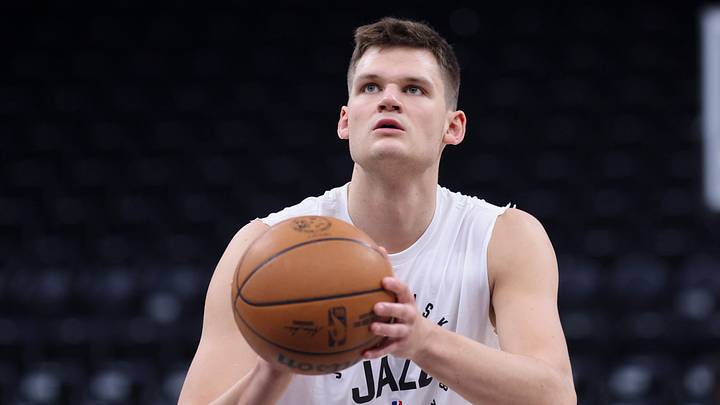
The Los Angeles Lakers have committed significant resources to upgrading at the center position. Deandre Ayton was at times over-criticized in 2025-26, but his shortcomings left the Lakers in need of a replacement who could excel in the areas in which there was room for improvement.
Though critics have questioned the price Los Angeles paid for him, most agree Walker Kessler is a situational upgrade over Ayton. The question is: What might that actually look like?
It's easy enough to say that Kessler is a better defender than Ayton in both consistency and general execution. Just as much of a blanket statement could be made that Ayton is the more proven and productive offensive player, however, with a more expansive skill set to boot.
What makes this move an on-paper improvement, however, is the more specific elements of what Kessler brings to the table that Ayton struggled to in 2025-26. That all starts with how the two approach and perform in defending the pick and roll.
Without hyperbole, that difference alone could transform the very essence of the Lakers' defense.
Editor's Note: Kessler appeared in just five games in 2025-26. Therefore, his 2024-25 season will be more consistently referenced for evaluation.
3. Drop coverage against the pick and roll
Kessler is the prototypical drop coverage big who resists the temptation to run out to the perimeter and instead cuts the paint off in its entirety. By no means is he averse to doing so, of course, as he ranked in the 99th percentile in screener mobile defense in 2024-25, per Basketball Index.
What makes him so disruptive, however, is the manner in which he puts his 7'4.25" wingspan and 9'5" standing reach to use as he waits to consume attempts to create shots at the rim.
Ayton deserves far more credit than he received for how well he did against the pick and roll in 2025-26, particularly when one factors in the Lakers' perimeter players' defensive inconsistency. There are simply levels to quality and impact in this regard.
What Kessler offers against the pick and roll is the presence of a shot-blocker and general interior powerhouse who can cut plays off at the pass.
With Kessler known to dominate the paint, opponents' efforts to run the pick and roll will be coordinated around drawing him out the perimeter. With his renowned proficiency in drop coverage, however, Los Angeles' guards and wings should have far more confidence in fighting over screens than they did with Ayton.
It's not necessarily because Ayton is a poor defender, but instead that he's better at meeting players at the rim than deterring them from reaching it.
2. Controlling the glass
Ayton has long been commended for his presence on the glass, but that doesn't mean there isn't a higher level than the one he's resided at. Additionally, there's reason to believe that Kessler's specialties may actually lend themselves more to Los Angeles than Ayton's.
That starts with the fact that, though Ayton averaged an impressive 3.4 offensive rebounds per 36 minutes in 2025-26, Kessler averaged 5.5 in 2024-25—and is at 4.8 for his career.
While Ayton is unavoidably productive, Kessler ranks among the most dominant offensive rebounders in the NBA. In 2024-25, he was No. 6 in the NBA in offensive rebounds per 36 minutes and finished in the 97th percentile in offensive rebounds per 75 possessions, per Basketball Index.
Ayton finished in the 87th percentile himself this past season, but Kessler's higher figure reveals that there is still a gap between them.
The primary reason to be intrigued by their rebounding disparity is how it translates to the defensive end of the floor. In 2025-26, Ayton ranked No. 26 in defensive rebounding percentage. In 2024-25, Kessler was No. 4.
Whether it's creating second chances or limiting them, Kessler is simply the more consistent of the two.
1. Rim deterrence—and how it opens things up for the perimeter players
The single biggest difference between Ayton and Kessler is how they deter opponents from even entering the paint. That's influenced in no small part by the difference in the way they meet opponents at the rim, with Kessler being one of the most dominant shot-blockers in the NBA.
Ayton averaged 1.3 blocks per 36 minutes in 2025-26—his highest mark since 2020-21—while Kessler averaged 2.9 in 2024-25. Kessler averaged 3.7 in both 2022-23 and 2023-24.
That's only a small part of defending, of course, but Kessler's dominance as a shot-blocker translates well to keeping opponents out of the paint. In 2024-25, he ranked in the 99th percentile in rim protection and rim disruption, as well as the 97th percentile in rim deterrence, per Basketball Index.
Ayton actually ranked in the 89th percentile in rim protection and the 91st percentile in rim disruption in 2025-26, but he placed in just the 46th percentile in rim deterrence.
That epitomizes why Kessler was prioritized. It's not that Ayton is a bad defender. That reputation has more to do with narrative than performance. Instead, it's that Kessler is in the rare tier of players who can make even top-tier scorers think twice about driving the lane.
Compounded by the fact that Kessler ranked in the 99th percentile in post defense and Ayton placed in the 76th percentile, the Lakers simply upgraded from good to potentially great in their role.
 Add us as a preferred source on Google