

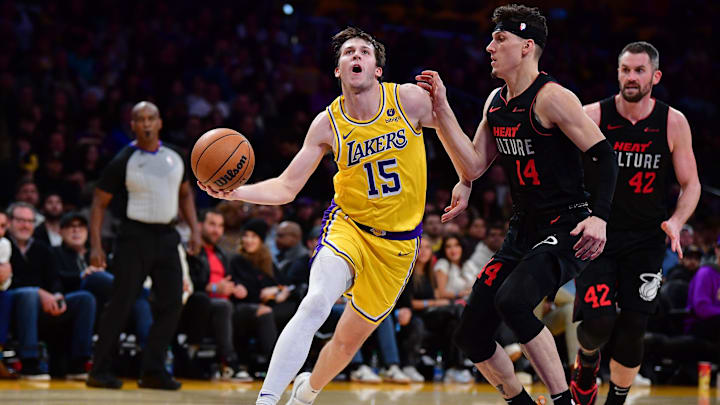
The Los Angeles Lakers have received an intriguing update about an Austin Reaves contract saga that could define their future. Reaves is reportedly coveting a salary in the range of $30 million per season, citing Miami Heat star Tyler Herro's four-year, $120 million deal as a reference.
If Reaves' goal is to match Herro's salary, then he must utilize the one edge he has over the Heat guard to his advantage: The physical attributes that permit a higher level of defensive play.
Herro has made remarkable progress on the offensive end of the floor during his six-year NBA career. He's become a high-level scoring threat and a more than proficient facilitator, earning significant accolades along the way.
Herro won the 2021-22 Sixth Man of the Year award and earned All-Star status for the first time in his career in 2024-25 after averaging 23.9 points and 5.5 assists per game.
Unfortunately, Herro has been identified as a lackluster defender whom opposing teams can isolate. One of the primary reasons for that brutal reality is the fact that Herro stands at 6'5", but has a 6'3.25" wingspan.
Reaves certainly doesn't have the length to rival Victor Wembanyama, but at 6'5" with a 6'6" wingspan, he has a key advantage over Herro as far as becoming a true two-way player is concerned.
Austin Reaves' longer wingspan creates greater two-way potential than Tyler Herro
Reaves may never defend like Oklahoma City Thunder star Jalen Williams, whose 7'3" wingspan can close the distance quicker than any two pair of feet in the NBA. What he can do, however, is match Williams' energy and intensity..
Herro has undoubtedly improved the energy he plays with on defense, but with the size and lateral quickness of a wing, but the wingspan of a point guard, matchups can make or break him.
Reaves doesn't have that issue, as his height, build, and wingspan enable him to defend his position at an at least adequate level. The question, of course, is whether or not he'll make progress from a consistency perspective.
Reaves has the physical tools to defend at a level that warrants respect as a two-way player, but he needs to improve his energy, intensity, footwork, and positioning.
In 2025-26, the Lakers allowed 113.3 points per 100 possessions with Reaves on the court and 110.6 when he wasn't. Beyond the numbers, he was routinely targeted in isolation and struggled to make the type of rotations needed of him.
If Reaves can address those issues in 2025-26, then he'll close the distance between himself and Herro—and there isn't much of a gap between them.
While Herro averaged 23.9 points and 5.5 assists per game in 2024-25, Reaves checked in at 20.2 points and 5.8 assists. Herro shouldered more offensive responsibility, but Reaves deserves praise for producing at a borderline All-Star level despite consistently playing behind two superstars.
Even if Reaves fails to overcome the divide as a scorer, putting the physical advantages he has on defense to use could earn him the Herro-level contract he's after.
 Add us as a preferred source on Google