

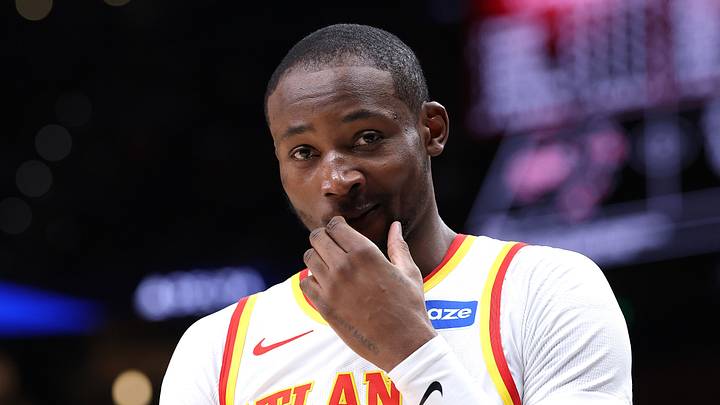
The Cleveland Cavaliers and Los Angeles Lakers are engaged in something of an arms race for free agent forward Jonathan Kuminga. At the same time, Cleveland is reportedly pursuing pathways to acquire Peyton Watson via sign-and-trade. If it succeeds in doing so, it'd conceivably remove itself from the Kumings sweepstakes.
With this in mind, the Lakers' best shot at a reasonable price for Kuminga could be waiting for the Cavaliers to land Watson. Unfortunately, if Cleveland can't get Watson, then the Lakers could lose Kuminga entirely.
Los Angeles is reportedly eyeing Kuminga to step into its starting lineup. That alone reveals how significant their interest is. Cleveland could potentially offer a similar opportunity, however, which is why their pursuits of Kuminga and Watson have seemingly become dependent on one another.
During a recent episode of The Game Theory Podcast, Sam Vecenie speculated that the the Cavaliers could be prioritizing Watson. In that scenario, Vecenie hypothesized that Cleveland could pivot to completing a sign-and-trade for Kuminga if they fail to land the Denver Nuggets standout.
"I also wonder if he's kind of in the Peyton Watson limbo at the moment where Peyton Watson is higher in the hierarchy than he is. And these teams like Cleveland and Milwaukee are trying to figure out: 'Hey, do we want Peyton Watson or not?' And they're waiting to see if they get Peyton Watson, and if not, maybe Cleveland goes for Jonathan Kuminga in a sign-and-trade of sorts."
Though it's merely speculation, Vecenie's take reflects the harsh reality that Los Angeles is facing: Its best opportunity for leverage in Kuminga negotiations could also push him to signing with Cleveland.
If Cavs land Peyton Watson, they may pass on Jonathan Kuminga—but what if they don't?
Whether fair or foul, the Lakers' financial situation is the deciding factor in how they should approach Kuminga. They've already given four-year contracts to Quentin Grimes, Walker Kessler, Sandro Mamukelashvili, and Austin Reaves this summer, and Luka Doncic will be eligible for free agency in 2028.
Furthermore, Jarred Vanderbilt has a $13,285,714 player option for the 2027-28 season. Unless he experiences a massive career turnaround, it's easy to envision him accepting it.
With this in mind, the Lakers have every reason to wait the Cavaliers' pursuit of Watson out. Doing so could mean gaining leverage in negotiations with Kuminga. That's a particularly essential piece to gain when one considers that players acquired via sign-and-trade must sign at least a three-year contract.
Los Angeles could conceivably offer Kuminga the first year guaranteed and then include options or partial guarantees in future seasons, but that brings them right back to having to outbid Cleveland—let alone appeal to Kuminga in the first place.
Lakers would get leverage in Kuminga negotiations if Cleveland drops out
Furthermore, Kuminga is an exceptionally talented player, but he isn't exactly a proven commodity in the NBA. It's known that he can score at a clip of 20.2 points per 36 minutes, but he's a career 33.2 percent three-point shooter and has been inconsistent on defense throughout his career.
There's an abundance of talent and upside to explore, but the lack of consistency makes a long-term deal rather difficult to stomach—particularly with so much guaranteed money already being shelled out elsewhere.
That creates the current dilemma. If Cleveland drops out, then Los Angeles could effectively be bidding against itself. There are other options, of course, as the Atlanta Hawks could re-sign Kuminga and the Milwaukee Bucks are reportedly interested in him, as well.
By eliminating a fellow championship hopeful from the discussion, however, the Lakers would gain leverage and potentially be able to avoid overpaying for Kuminga.
Lakers are a better option, but that doesn't mean they'll land him
In one writer's opinion, the Lakers are a better option for Kuminga than the Cavaliers would be. Both teams have a ball-dominant backcourt pairing, but Los Angeles lacks a clearly defined third scoring option. Kuminga could conceivably slot into that role with a number of floor spacers around him.
Cleveland, meanwhile, has a pair of All-Star big men in Jarrett Allen and Evan Mobley, which could limit the opportunities for a slashing scorer like Kuminga to play his preferred style.
The reality of free agency, however, is that contract structure is as relevant as on-court strategy. If the Lakers are unable to put together an offer that Kuminga feels is better for his career and life than the Cavaliers', then that may ultimately prove to be the bottom line.
The question is: Can the Lakers risk gaining leverage if the alternative is losing Kuminga entirely? Unfortunately, a potentially overpay may prove necessary if they aren't willing to risk it all.
 Add us as a preferred source on Google