

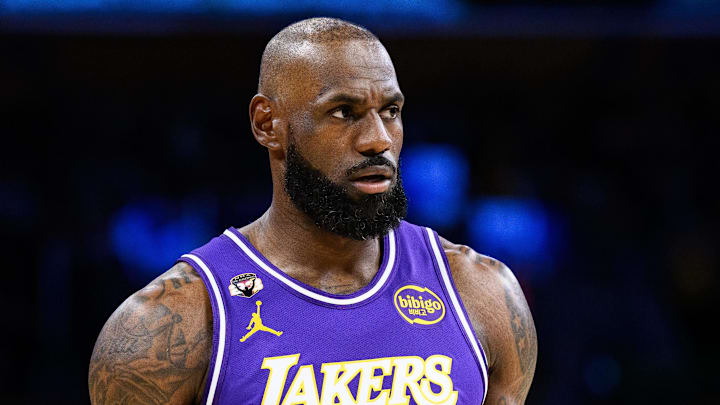
The Los Angeles Lakers were absolutely dominated by the Houston Rockets in Game 4, falling 115-96. From the opening tip, it felt like the Rockets brought more energy, attention to detail, overall intensity, and the Lakers straight up got punked. What also contributed to this disaster was their inability to create from the perimeter.
In this series, Houston has been the tougher, more physical team. That's simply their brand of basketball. Where LA always had them beat was shot-making, specifically from the perimeter.
In Game 1, Houston made 11 triples. LA made However, the Lakers also shot 52.6 percent while the Rockets shot 33.3 percent. In Game 2, LA hit 13 threes on a 46.4 percent clip, and Houston made seven threes on a 24.1 percent clip. In Game 3, the Lakers hit 12 threes on 41.4 percent shooting, and the Rockets made 11 threes on 28.2 percent shooting.
You get the point. All series, LA has made more treys or shot the deep ball more efficiently than Houston. That was a massive reason the Lakers led 3-0.
Game 4 told a different story. LA veered away from the perimeter game that had them dominate the Rockets. The Lakers made just five long balls, shooting 22.7 percent from the perimeter, while Houston went 12-of-30 for an even 40 percent.
Lakers abandoned their identity from deep with sweep on the line
Rockets head coach Ime Udoka had lit a fire under his team, and they brought more urgency than we've seen all series with their season on the line. They also did a much better job running shooters off the perimeter and trying to get LA to attack the basket.
However, that can't be an excuse, as the Lakers' gameplan seemed completely different from what it was in the first three games of the series. For most of the night, the Lakers ran their offense like it was the 1980s, and the 3-point line wasn't an effective way to score.
The guards fed Deandre Ayton. While he had a great night, that was exactly what Houston was hoping LA would do, as it limited their shots from beyond the arc.
After one quarter, LA had attempted just two 3-point shots. That's not a typo. In the second quarter, they only got up four. While I appreciate JJ Redick and his staff making the math easier for me, seeing the Lakers take only six 3s in the first half is mind-boggling.
The Lakers started to take more as the game went on, with 16 in the second half, but LA only started attempting them when the Rockets pulled away, and they had no other answers. The lack of takes in the first half made watching LA shoot down the stretch an eyesore, as no one was in rhythm—hence, even though the margins improved, the results didn't.
Before this round one series even tipped off, everyone in the NBA world knew the Lakers' key to beating Houston without Luka Doncic and Austin Reaves was the 3-ball. Through three games, it appeared the Lakers staff was aware of that.
On Sunday night, they took a massive step in the wrong direction. If they don't get back to their old ways, this could become a real series.
 Add us as a preferred source on Google