

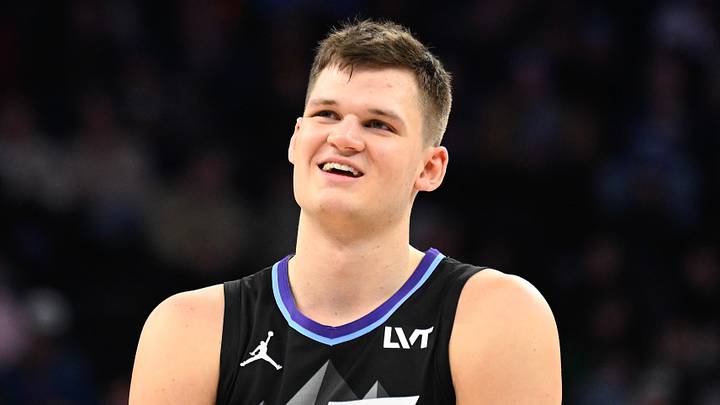
The Los Angeles Lakers have been on the receiving end of fairly consistent criticism since signing Walker Kessler on Jul. 1. Los Angeles gave up two unprotected first-round draft picks and another two pick swaps, and signed the polarizing big man to a four-year, $130 million contract.
For all of the risk that the Lakers incurred in the Kessler transaction, the manner in which Jalen Duren, Jonathan Kuminga, and Peyton Watson dragged out their own periods of free agency has offered vindication.
Los Angeles had a need for a starting center and the money to spend on a new player. Perhaps it gave up too much for a talented big who missed 76 games in 2025-26 and 24 in 2024-25, but calculated risk is an inevitable element of free agency. Nevertheless, the criticism has been steady.
Revered NBA analyst Zach Lowe was one of many to call the Kessler move an overpay, claiming that the Lakers "are now trapped" based on what they gave up to get him (h/t Gautam Varier of Yahoo! Sports).
"There is no question that they overpaid for him and are now trapped with this team and have to figure out either this is the team or is there a way to pivot by trading Austin Reaves down the line or something like that because they're out of tradeable assets because of the Walker Kessler deal. All that said, he's played no meaningful games in the NBA, basically, and barely played at all last year."
Lowe put a bowe on his take, comparing the Kessler deal to the New York Knicks trading for Mikal Bridges in the sense that he needs to prove he's worth it.
"And so, yeah, I mean, fairly or not, those assets, much like happened to Mikal Bridges, they're going to hang around his neck until he proves that he was worth it."
Lowe's take is bold, although at least somewhat understandable, but the Lakers' vindication is already coming from how other players' periods of free agency have played out.
Long, drawn out periods of free agency have vindicated Lakers' "overpay"
As of the publishing of this article on Sep. 3, Duren is still a free agent. His refusal to accept the Detroit Pistons' preferred offer has left a 60-win team with few options, if any, beyond ultimately paying him what he wants or facing the risk of him potentially accepting his qualifying offer.
The latter outcome would result in Duren playing for the Pistons in 2026-27, but he'd become an unrestricted free agent the following summer.
Jonathan Kuminga put the Lakers through something similar, drawing out his free agency until late August. Los Angeles reportedly viewed Kuminga as a potential starter, but the unrestricted free agent ultimately spurned them for less money by signing with the Minnesota Timberwolves.
Peyton Watson did the same to the Denver Nuggets when he joined the Cleveland Cavaliers via sign-and-trade on Aug. 20—when the pool of remaining free agents had all but dried up.
Jalen Duren is still an RFA—Detroit would struggle to replace him now
There's a fair argument that most of the blame falls on the team, rather than the player, in these situations. Duren and Watson, for instance, were extension-eligible and made it clear to Denver and Detroit what they're hoping to receive as an annual salary early in free agency.
Along those same lines, the Lakers could've pivoted to another option but ultimately stayed the course with Kuminga and now have a positional battle between players whose history in the NBA doesn't exactly scream, "Starter on a championship hopeful."
And then there's Kessler. Overpaid or not, the Lakers knew exactly what they wanted to prioritize at the center position and they went out and got it. They were thus in a significantly more stable position in August and September than some of their peers.
More importantly, they solidified their rotation with an interior anchor who addresses some of their most burning questions on either end of the floor.
For one, signing Kessler gives the Lakers a rim protector who can control the interior and simplify the game for his offensively-inclined teammates. He's also an elite offensive rebounder who can create second chances, which gave Los Angeles further reason to part ways with Deandre Ayton after a polarizing 2025-26 campaign.
It may have cost the Lakers a pretty penny, but they created stability within their rotation and removed uncertainty from their offseason pursuits by paying what they had to for the player they wanted.
Peyton Watson didn't sign until Aug. 20, Jonathan Kuminga until Aug. 26
It's the unspoken truth about overpays in the NBA. Yes, they happen. And yes, they can prove quite harmful. In order to acquire top talent, however, assets will need to be exchanged—particularly in a day and age when teams are far less likely to let their best players reach free agency.
Furthermore, draft picks are invaluable assets—and the Lakers' history of shipping them out for rentals has cost them dearly. Kessler, however, signed a four-year deal.
Los Angeles has thus invested the outgoing draft picks in a player they believe can anchor their interior for the rest of the decade. That's not the same as giving up first-round picks for potential rentals like Dennis Schröder or questionable fits like D'Angelo Russell and Russell Westbrook.
Lowe is right. Kessler will need to justify the "overpay." What's simultaneously true, however, is that the Lakers avoided months of uncertainty and potential heartbreak by simply paying what they had to for the player they wanted and arguably needed.
The Duren, Kuminga, and Watson sagas all prove how detrimental waiting for the right deal to magically appear could've been.
 Add us as a preferred source on Google