

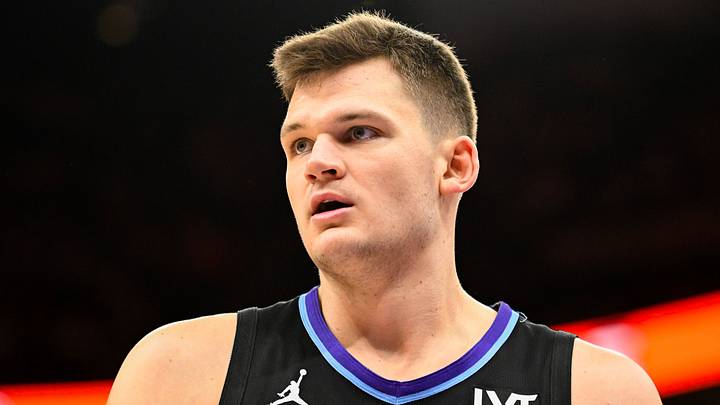
The Los Angeles Lakers traded Deandre Ayton, let Jaxson Hayes walk in free agency, and invested in three new centers: Walker Kessler, Kevon Looney, and Sandro Mamukelashvili. Each of the newcomers brings something different to the table, and each represent a collective improvement at a pivotal position.
In addition to upgrading over Ayton as a starter by signing Kessler, the Lakers have improved their depth and created a degree of rotational versatility that they simply lacked in 2025-26.
The harsh reality of how the Lakers proceeded through the 2025-26 season is that they didn't necessarily have an ideal option for a certain set of circumstances. They had two playable centers in Ayton and Hayes, and they simply hoped that their skill sets would suit the situation at hand.
With a rotation of Kessler, Looney, and Mamukelashvili, however, Los Angeles now has three centers who can all play different roles depending on what the situation calls for.
With Kessler, the Lakers have a big they can play in the neighborhood of 30 minutes per game and trust to control the defensive interior, finish lobs, and dominate the offensive glass. With Looney, it's elite screen-setting, championship-winning poise under pressure, and equally elite offensive rebounding.
Throw in Mamukelashvili's well-rounded offensive skill set and the Lakers can control the interior, play five out, prioritize the pick and roll, and match up against taller and smaller lineups alike—and they have three quality options to turn to for said scenarios.
Lakers' upgrades at center: The starter, the depth, and the optionality
Mamukelashvili, who played 93 percent of his minutes at center in 2025-26 and 60 percent in 2024-25, offers the new-look strength of being able to create optimal spacing. A season ago, he buried 1.4 three-point field goals per game while shooting 38.9 percent from beyond the arc.
That alone gives Los Angeles a new look at the 5-spot considering Ayton and Hayes combined for three three-point field goal attempts during the entire 2025-26 season.
In addition to being an effective and efficient shooter, Mamukelashvili is a productive shot creator. He averaged 11.2 points per game and 18.4 points per 36 minutes in 2025-26, and ranked in the 71st percentile in self-created shot making efficiency, per Basketball Index.
With Mamukelashvili in the rotation, the Lakers will have the option to run out rotations that intend to blitz opponents offensively—an approach neither Ayton nor Hayes were ideal for.
Lakers can prioritize spacing, defense, or rebounding at any given time
Kessler and Looney admittedly have fairly similar skill sets, albeit while not being carbon copies of one another. Kessler is more of a shot-blocker and drop coverage specialist, whereas Looney has thrived as a team defender and rebounder.
The shared quality they possess is simple: During their most recent healthy seasons, 2024-25, Kessler averaged 5.5 offensive rebounds per 36 minutes and Looney somehow outpaced him at 5.8.
Furthermore, only Chet Holmgren and Victor Wembanyama have compiled a better defensive field goal percentage than Kessler since he was drafted in 2022. As for Looney, he's a three-time NBA champion who helped anchor the interior for the Golden State Warriors.
Los Angeles entered the offseason with center as a known weakness, but it will now enter training camp with a chance to make it a definitive strength.
 Add us as a preferred source on Google