

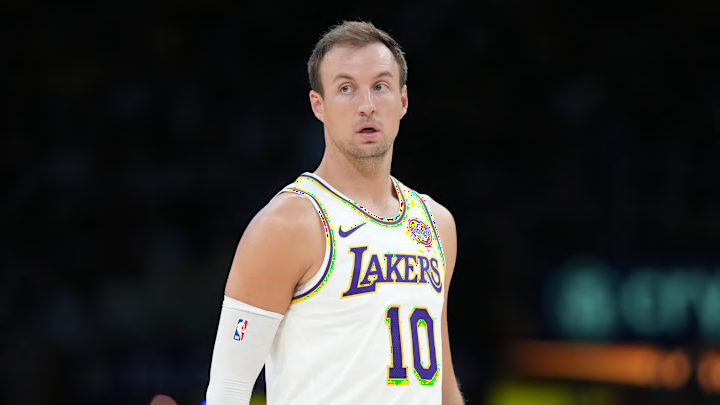
Los Angeles Lakers swingman Luke Kennard has been exactly who the franchise expected him to be. He's come in, shot the lights out, and offered an invaluable source of offensive production and spacing that has helped diversify the Lakers' offense.
As the postseason nears and an alarming dilemma rears its head, however, a key question persists: How alarmed should Los Angeles be by how much worse they are on defense when Kennard plays?
Kennard is a nine-year NBA veteran who has made four trips to the playoffs. He's played an average of 19.3 minutes per game, thus suggesting he has a decent idea of what to expect once the postseason begins and teams attempt to target him on defense.
Knowing what to expect and being able to do something about it are two vastly different talking points, however, and there are rational concerns over how Kennard will perform in the postseason.
The Lakers are currently allowing a team-worst 117.5 points per 100 possessions when Kennard is on the court. That number plummets to a team-best 106.9 when he's off the court. To put it plainly: That drastic change of 10.6 points per 100 possessions is difficult to overlook.
The question is: Are Kennard's defensive issues harmful enough to prevent the Lakers from producing positive minutes when he's on the court in the playoffs?
Lakers' defense is infinitely better without Luke Kennard. How much does it matter?
The good news for the Lakers is that, despite Kennard's defensive woes, they're outscoring opponents by 2.2 points per 100 possessions when he's on the court. The confusing piece of the puzzle, however, is that they're outscoring opponents by a team-best 5.9 when he isn't.
The Lakers will have every reason to proceed with smiles on their faces if they continue to outscore opponents with Kennard on the court, but the current outlook screams unsustainable.
In a regular season setting, Kennard can be somewhat hidden on the defensive end of the floor. The quality of opponents typically varies from night to night, and even when there's a rush of high-level teams on the schedule, the worst-case scenario is a back-to-back against one team in specific.
Come the playoffs, however, the Lakers will have a specific postseason-caliber opponent game-planning for how to exploit mismatches for a minimum of four consecutive games.
Kennard sticks out in that regard, as he ranks in the 32nd percentile in perimeter isolation defense, per Basketball Index. In the event that teams begin to target him, it thus becomes fair to question whether or not the Lakers can consistently play him knowing how important it will be to make stops.
Keep in mind: The Lakers are 19-4 when they allow 110 points or less and 26-21 when they allow 111 or more. As such, defense is a rational priority. It simply remains to be seen how Kennard will adapt come the playoffs.
 Add us as a preferred source on Google