

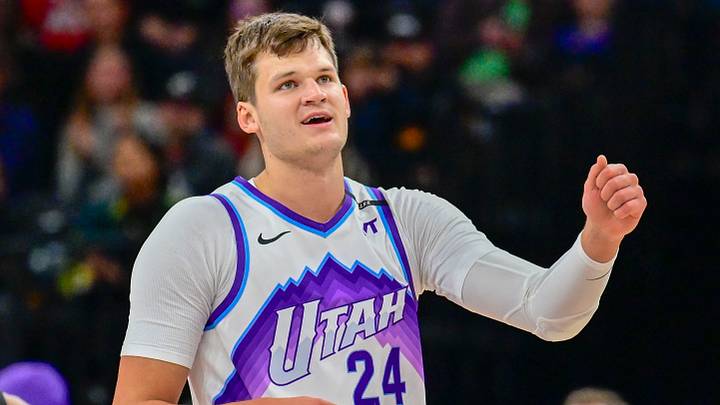
Peyton Watson was a name who was linked to the Los Angeles Lakers throughout the 2025-26 season and up until the offseason. When the free agency chaos began, Rob Pelinka and company pushed for Walker Kessler as their main prize instead. After Watson finally found a new home, it has become even more clear this was the right call for the Lakers.
Shams Charania reported: "BREAKING: Cleveland, Denver and the Clippers have agreed on a trade sending Peyton Watson to the Cavaliers, Max Strus to LA, and an unprotected 2031 Cavs first-round pick and a 2032 Kings second-rounder to the Nuggets, sources tell ESPN."
Charania added that Watson's new deal with the Cavaliers is estimated at $88 million over the next four years. $22 million on average for that good of a two-way forward? That looks great on the surface. Some may even think the value there reaffirms why Lakers pushed too hard and too early for Kessler. They would be wrong.
Contract numbers of Walker Kessler and Peyton Watson do not define value for the Lakers
The Lakers are paying an annual average of roughly $32.4 million to Kessler over his four-year deal in Los Angeles. That makes Watson the better value at $22 million, right?
From a strict crunching the numbers standpoint? Sure. From the larger scope? Absolutely not.
As a center, Kessler is able to have such a larger impact on the Lakers as a whole. The entire defense in Los Angeles should be built around him next season. Watson is strong on that end, and a capable stopper on the wings, but the 25-year-old big man can carry a gameplan by himself far more effectively.
Couple that with what should be a seamless fit next to Luka Doncic on offense, and Kessler should have a much larger impact. To that end, it makes more than enough sense as to why the Lakers forked over a bigger salary to their new center.
Peyton Watson's drawn-out free agency would have hurt the Lakers
The other element here is that it took Watson until Aug. 19 to sign his new contract. There is certainly an argument to be made for why the Lakers could have forced the Nuggets' hand much sooner than the Cavaliers did, but it also required a specific set of circumstances for Denver to fully embrace letting him go.
Sam Presti and the Oklahoma City Thunder pushed the Nuggets firmly into the second apron with the Spencer Jones offer sheet. At that point, Denver was stuck. Moving Watson felt like an inevitability.
How much would the Lakers' summer have been hurt by waiting on the Nuggets? A part of the reason why Los Angeles surrendered what they did to the Utah Jazz in the form of draft capital was to get the rest of their business going. Standing still for Watson would have hurt their best asset: timely spending power.
Plus, the Lakers are still sitting in a position where they can address the starting forward spot with Jonathan Kuminga. Kuminga is not as great of a fit as Watson would have been in Los Angeles, but Kessler plus Kuminga would easily trump Peyton and whatever underwhelming center they could have paired up with him. Los Angeles got it right.
 Add us as a preferred source on Google