

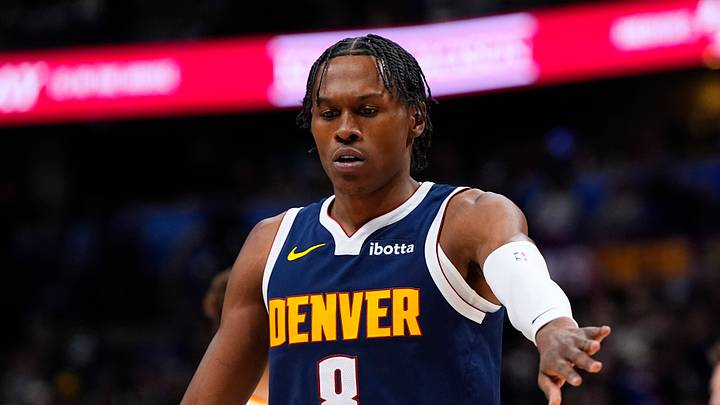
The Los Angeles Lakers were a known suitor for Denver Nuggets restricted free agent Peyton Watson entering the 2026 offseason. After conducting a complete and costly roster overhaul, however, the dream of signing Watson was put on the backburner—until the Nuggets lowered the asking price to acquire him via sign-and-trade.
Unfortunately, even with a lower asking price, the Lakers lack the resources to make an offer for Watson that the Nuggets would have reason to consider—or that they could afford to part with.
Denver reportedly extended an offer of $70 million across five seasons. That has seemingly fallen well short of the five years and $125 million that Watson is reportedly seeking. That divide has spawned a development that could have the Lakers feeling optimistic.
Shams Charania of ESPN was one of many to report that the Nuggets have now lowered the asking price for Watson in a potential sign-and-trade to a high-level player and a first-round draft pick.
Shams on Peyton Watson negotiations with the Nuggets:
— Oh No He Didn't (@ohnohedidnt24) July 28, 2026
"In a potential sign and trade, the Nuggets initially had set a price this off season of similar to the Walker Kessler deal of two first and two swaps in any potential deal. Now that price, my understanding is a really good… pic.twitter.com/9xDiDhiiyr
For as intriguing as that may be, the Lakers don't have the resources to acquire Watson—and there's a fair case to be made that they shouldn't try to scrounge them up.
Lakers can't afford Peyton Watson—and that isn't necessarily a bad thing
Watson is an undeniably appealing player. He's 23 years of age, and in 2025-26, shot 41.1 percent from beyond the arc while ranking in the 97th percentile in perimeter isolation defense, the 92nd percentile in off-ball chaser defense, and the 86th percentile in ball screen navigation, per Basketball Index.
Compounded by his developing shot creation skills, Watson could conceivably become one of the best two-way players in the NBA over time.
The harsh reality about Watson and the cost of acquiring him is that the sample size of his success is rather small. He didn't crack 20.0 minutes per game until 2024-25, when his averages translated to 12.0 points, 5.1 rebounds, 2.0 assists, 2.0 blocks, and 1.0 steal per 36 minutes.
In 2025-26, those numbers jumped in some respects to 17.8 points, 5.9 rebounds, 2.5 assists, 1.4 blocks, and 1.1 steals per 36 minutes—but he only played 54 games.
Perhaps Watson can sustain that 54-game sample size across a full season and continue his progression into a top-tier two-way wing. To lose even more draft assets simply isn't an option for a maybe, particularly when the Lakers only have three of their next seven first-round picks and no second-rounders until 2031.
Los Angeles would clearly be wise to discuss a sign-and-trade and learn what the actual price would be, but in terms of what was outlined in outgoing assets and salary, it's past what they can reason.
 Add us as a preferred source on Google