

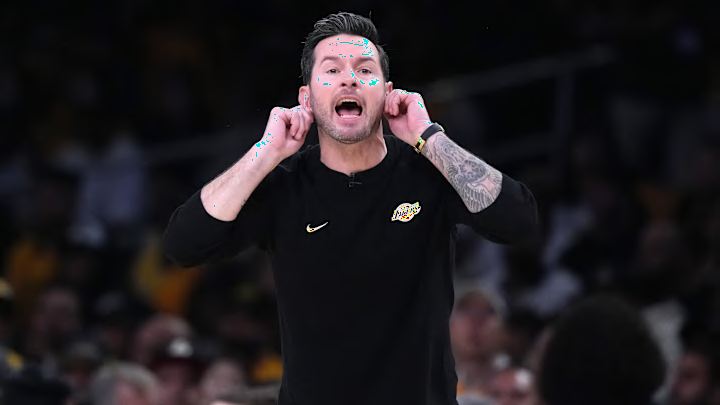
The Los Angeles Lakers spent their previous three trips to the postseason struggling to figure the Denver Nuggets and Minnesota Timberwolves out. They not only lost each of the three series they played against Denver and Minnesota, but won just two of a possible 14 games.
As the Lakers search for ways to overcome injuries and the Nuggets and Timberwolves engage in a slugfest of a first-round series, one thing remains clear: Los Angeles must learn the value of depth.
Denver and Minnesota entered the playoffs with two superstars leading remarkably deep rotations. For the Nuggets, three-time MVP Nikola Jokic is flanked by All-Star guard Jamal Murray, a remarkably balanced starting lineup, and a second unit that's flush with proven talent.
The Timberwolves, meanwhile, have three All-NBA teammates in Anthony Edwards, Rudy Gobert, and Julius Randle, as well as a tremendous supporting cast that includes a former Sixth Man of the Year.
The two injury-plagued contenders have inevitably found themselves in the midst of an evenly split series at 1-1. Though one of the two teams will unfortunately be sent packing, they've reached the level of contender status by complementing their top-tier players with reliable support.
If the Lakers can learn anything from the teams they keep being eliminated from the playoffs by, it's that they must invest in creating high-level depth of their own. It seems they're beginning to do so.
Nuggets, Timberwolves continue to show Lakers the value of depth
Six players scored in double figures for the Timberwolves during their Game 2 win, with Ayo Dosunmu adding nine points and five assists. Gobert scored just two points, but played tremendous defense against Jokic. All in all, it was the epitome of a balanced win.
Rewind the series by one game and Denver won behind all five scorers finishing in double figures and Bruce Brown adding nine points, six rebounds, and five steals off the bench.
Los Angeles has thankfully followed suit early in the playoffs, with all five starters scoring in double figures during the Game 1 win over the Houston Rockets. That includes Luke Kennard, who scored 27 points on 9-of-13 shooting to lead the charge.
The question facing the Lakers is quite simple: Once the stars return, will they still invest in the value that the supporting cast provides?
Los Angeles was one of just two teams to average fewer than 30 bench points per game in 2025-26. As fate would have it, Houston was the other. That poses a fair question, particularly when factoring in past postseason results: Can the Lakers realistically compete against a deep rotation?
If Denver and Minnesota have proven anything by dominating the Lakers in the playoffs, it's that Los Angeles must trust its second unit and invest in improving it this coming summer.
 Add us as a preferred source on Google