

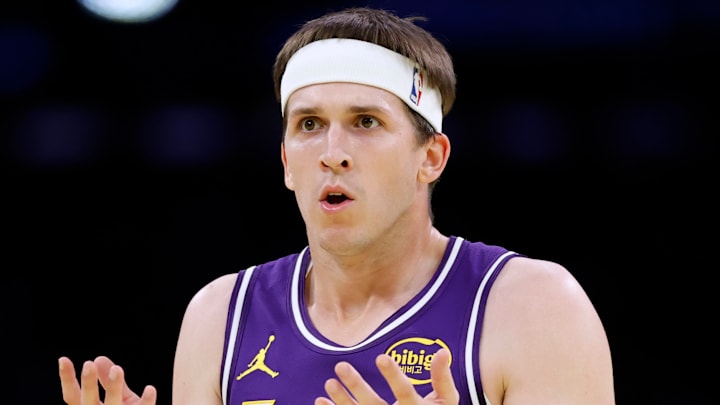
Implications of Austin Reaves missing time with a left calf strain abound for the Los Angeles Lakers. You can now go ahead and add another one to the laundry list of fallout developments: The Lakers are less likely to swing a meaningful trade by the deadline.
This is not meant to imply that Reaves was on the table in prospective negotiations. He almost assuredly wasn’t. And even if he were, he is definitely not anymore.
Reaves’ absence is instead a reminder of the fine lines that the Lakers are towing. They were already at a disadvantage in possible talks when looking at their available assets. Now, in addition to a lack of appealing trade chips, they may now be facing a dearth of motivation.
Austin Reaves’ injury could hamper the Lakers’ place in the standings
Reaves is scheduled to be re-evaluated in four weeks, according to ESPN’s Dave McMenamin. This does not mean he will be back in four weeks. It’s a timeline for when the Lakers will (likely) provide another update on his status.
Navigating this stretch without Reaves will be far from a cinch. Losing his minutes could allow JJ Redick to tilt toward more defensively oriented lineups, but this presumes the Lakers even have the personnel to make such an adjustment. They might not. Redick himself sure doesn’t seem to think they do.
Trusting that the offense can remain elite without Reaves is a more attainable goal. It also isn’t a given. Luka Doncic is a defense-disorienting wrecking ball unto himself. But the minutes he’s playing alongside LeBron James are not going well. Like, at all.
The Lakers have a luck-adjusted net rating of minus-4.7, with a defensive rating of 123.7, when the two legends share the floor. The returns don’t get much better in minutes without Reaves. The defensive performance actually gets worse.
Granted, this is an extension of the Lakers’ most awkward issue. They have grossly underperformed with all three of their stars in the game—including on the offensive end, where they average a dismally low 113.6 points per 100 possessions (also adjusted for luck). This isn’t tantamount to a silver lining. Things aren’t guaranteed to just get better, or smoother, because there’s one fewer mouth to feed.
There is no telling, then, how much exposure the Lakers have to tumbling down the standings over the next month. Just two losses separate them from play-in territory. And if they slip out of the top six, the front office will have to ask an uncomfortable question: What’s the point of doubling down on this season?
The Lakers seem less likely to make a meaningful trade
Convincing yourself that the Lakers should preserve assets and flexibility for the summer wasn’t hard before. It’s even easier now.
They can flip one first-round pick at the moment (2031, or 2032). That number climbs to three over the offseason (2026, 2031, and 2033), when they could also have more than $50 million in cap space while carrying Reaves’ free-agency hold. The ceiling on what they can do then is significantly higher than it is right now.
It would be one thing to act earlier if it results in the Lakers entering the inner circle of contenders. But does adding someone like Herb Jones actually accomplish that? Is he really all that separates L.A. from the likes of the Oklahoma City Thunder, Denver Nuggets, Houston Rockets, and even San Antonio Spurs over the course of a seven-game series?
The brutally honest answer is no. And though there previously may have been more room for debate, it has since dissipated. The Lakers just lost no worse than their third-most important—and likely second-most important—player. They won’t be getting him back until there’s two weeks or less remaining before the deadline. That doesn’t give them a lot of time to evaluate the progress of the Luka-Reaves-LeBron dynamic, and also makes a trade that both fits and elevates it.
In all likelihood, the Lakers were probably never going to make a major splash before February 5. The Reaves injury takes that “probably,” and turns it into a near-certainty.
 Add us as a preferred source on Google