

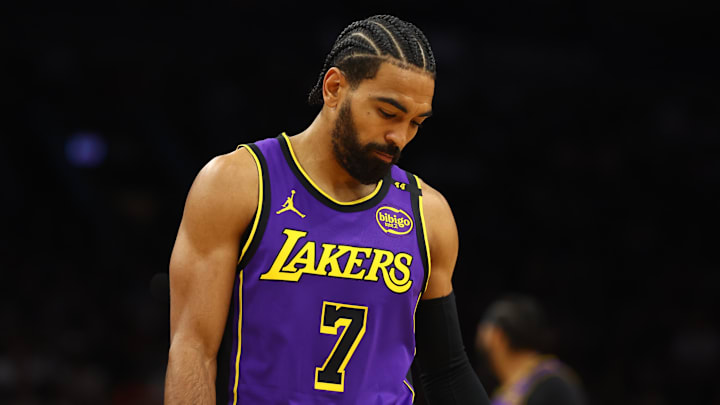
When the Los Angeles Lakers signed Gabe Vincent in 2023, the appeal was obvious. Vincent had just ripped off five 20-point games during the playoffs and played a pivotal all-around role as the Miami Heat made an improbable trip to the NBA Finals as a No. 8 seed.
If there's one lesson to be learned from the Vincent experience, however, it's that a player's value to a championship hopeful depends as much on fit and contract as anything else.
Los Angeles signed Vincent to a three-year, $33 million contract during the 2023 offseason. It seemed to be a fair deal for a player who'd established himself as a quality scorer and defender, and was admittedly joining a team that had just reached the Conference Finals.
Vincent's lack of efficiency from beyond the arc and limited nightly production as a scorer, however, made him a somewhat questionable fit for a team that lacked stability at point guard.
Austin Reaves looks the part of a star today, but even if Vincent hadn't missed all but 11 games in 2023-24, there would've been colossal pressure on both players to overachieve. It was a risky bet considering Reaves' career-high was 13.0 points per game and Vincent's was 9.4. Furthermore, their flaws were noteworthy: Defense for Reaves and three-point efficiency for Vincent with a then career mark of 33.9 percent.
It's water under the bridge at this stage, but the result was perhaps inevitable: Vincent struggling to provide the offense the Lakers needed and Reaves underwhelming on defense.
Lakers can't give long-term deals to imperfect fits in free agency
There's clearly a case to be made that Vincent was a wise player to pursue. His defensive intensity and postseason experience appeared to be ideal on the basis of helping a Conference Finalist get over the hump and reach the NBA Finals.
The issue with signing him, however, is one that the Lakers can't afford to repeat in 2026: Handing him a fully guaranteed three-year deal.
Though the virtues of the signing were clear, the risks were also well-known. Despite the realistic possibility of Vincent being a poor fit, however, the Lakers consumed precious cap space with multiple max-level salaries already being paid and disregarded the potential need for financial relief.
Los Angeles is now in an eerily similar position with Luka Doncic making $49.8 million in 2026-27, Reaves on pace to make a hefty salary himself, and LeBron James' unrestricted free agency looming.
Rather than committing to three and four-year deals—the latter of which the Lakers are still paying to Jarred Vanderbilt—Rob Pelinka must make their risky endeavors short-term in their nature. That can not only permit Los Angeles to endure financial burdens more easily, but potentially trade their way out of mistakes.
Vincent was oftentimes overly criticized during his Lakers tenure, but if his two-and-a-half seasons proved anything, it's that financial responsibility will be essential to maximizing the Doncic era.
 Add us as a preferred source on Google