

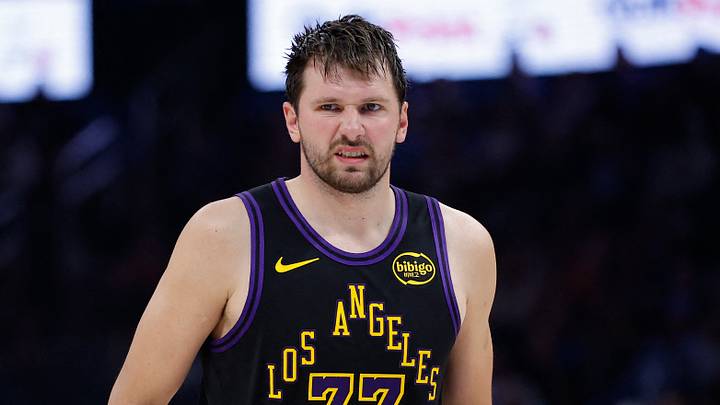
Remove the names and contracts from the equation. Look simply at how the Los Angeles Lakers have reinvented themselves this summer. They've surrounded Luka Doncic with a high-level shot creator, an elite rim protector and rebounder, and a younger cast of athletic wings who can shoot with a baseline of reasonable efficiency. From that perspective, they're trending in the right direction.
The fine print, however, reads as follows: Los Angeles has put all of the right pieces next to Doncic based on his style of play, but they've done so with long-term contracts they'll struggle to get out of if they ultimately need to do so—and they have no idea if their new additions will actually fit.
Los Angeles re-signed Austin Reaves to a four-year, $180 million contract. Reaves is a homegrown talent who's the exception to the aforementioned rule, as he's played remarkably well alongside Doncic. With LeBron James no longer present, keeping some degree of stability was clearly important.
Doncic has also benefited from playing alongside top-tier shot creators in the past, as he reached the Conference Finals with Jalen Brunson and the NBA Finals with Kyrie Irving.
The jury is out on whether or not Reaves was overpaid, however. He's a dynamic shot creator who has averaged in excess of 20.2 points and 5.5 assists per game in each of the past two seasons. In saying that, he's also a subpar on-ball defender who has struggled in the playoffs.
That only scratches the surface of how the structure of the Lakers' contracts could be as detrimental as the talent they've signed could be beneficial.
Lakers have right strategy for helping Luka—but contracts are a red flag
Walker Kessler was the other big-money move at four years and $130 million. Kessler has been nothing less than elite as a rim protector and rebounder in the past, ranking in the 99th percentile in rim protection in 2024-25, per Basketball Index, and boasting career averages of 3.4 blocks, 13.4 rebounds, and 4.8 offensive boards per 36 minutes.
Kessler missed 76 games due to shoulder surgery in 2025-26, however, and was absent from 24 in 2024-25. If the injury bug returns, his $32.5 million annual salary could prove tough to trade.
Next on the list is Quentin Grimes. Grimes is a catch-and-shoot specialist and an excellent wing defender. In 2025-26, he buried 38.3 percent of his catch-and-shoot threes, and ranked in the 87th percentile in perimeter isolation defense and the 93rd percentile in off-ball chaser defense, per Basketball Index.
Though that makes him a great fit on paper, he signed a four-year, $60 million deal. If he struggles to make the fit work on the court, that makes him another player who could be difficult to move.
Can the Lakers offload hefty long-term salaries if they don't pan out?
The last of the known roster additions who could prove challenging to trade if they struggle is Sandro Mamukelashvili. Mamukelashvili is an excellent shooter and volume scorer. He carries career averages of 17.2 points and 2.2 three-point field goals made per 36 minutes into the 2026-27 season, and shot 38.9 percent from beyond the arc in 2025-26.
In saying that, Mamukelashvili struggles to defend in space and signed a four-year, $52 million deal to join the Lakers. The same concern thus exists: If he fails to live up to expectations, how easy will it be to move his long-term deal?
It's easy to say that this is putting the cart in front of the horse, but the Lakers are already in this nightmare scenario with Jarred Vanderbilt. Vanderbilt is entering the third season of a four-year, $48 million deal. Injuries play a part, as he appeared in just 29 games in 2023-24 and 36 in 2024-25.
Vanderbilt played 65 games in 2025-26, however, and continued to be an excellent defender. His lack of an ideal jumper limited his minutes, though, and the Lakers have thus struggled to trade him this summer.
Jarred Vanderbilt is proof of how hard it is to trade unfavorable contracts
Suppose Kessler experiences the same injury issues as Vanderbilt. Hypothesize that Mamukelashvili could be the inverted version of Vanderbilt as a strong shooter who struggles to defend. Imagine a scenario in which Grimes simply doesn't play up to the level of a $15 million annual salary.
Suddenly, the Lakers would have a brand new Vanderbilt situation on their hands—all the while facing the harsh relaity that they still have two years left on his deal.
In that scenario, the quality of the new additions on paper wouldn't just be overshadowed by potential underperformance on the court. The ability to move off of their contracts and replace them with better fits would become a challenge dictated by the very long-term contracts Los Angeles signed them to without knowing how they actually fit in head coach JJ Redick's system.
That's made all the more alarming by the fact that Los Angeles is pursuing yet another unknown in Jonathan Kuminga—a talented and athletic forward with a faulty jumper and a history of defensive inconsistency.
Jonathan Kuminga would add to high-risk, high-reward summer
It'd be simple enough to take a chance on Kuminga if the Lakers could afford to sign him outright. Unfortunately, they can't—not for any more than a minimum salary that he's reportedly unwilling to entertain. As such, landing him would require a sign-and-trade—and the CBA dictates that any sign-and-trade must result in a minimum of a three-year deal for a presently unsigned player.
Kuminga could potentially accept team options or partial guarantees being placed in the contract, but if he declines their inclusion, then the Lakers would have yet another long-term deal on their hands.
It's the inherent flaw of what truly is an otherwise brilliant summer for the Lakers. Los Angeles has surrounded Doncic, an offensive dynamo who's built for a heliocentric system, but is also known to be inconsistent on defense, with shooters, defenders, and lob threats.
Unfortunately, it's done so by handing out long-term contracts that could hinder their ability to make changes if certain deals fail to pan out. Essentially: They've gone all-in on a hand they haven't even seen.
 Add us as a preferred source on Google