

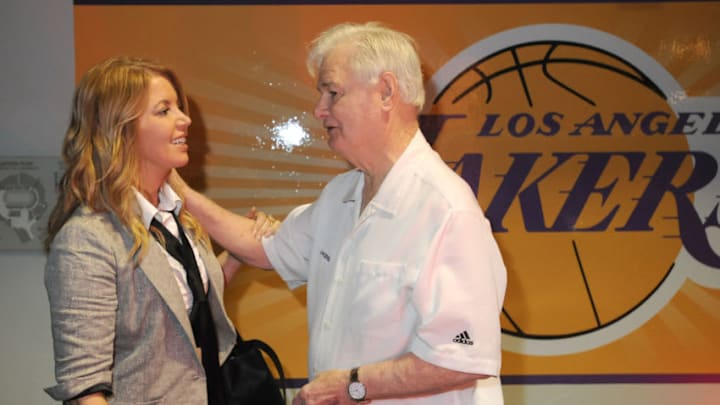
The Los Angeles Lakers became the team of the decade in the 2000s thanks to the talent, skill and will of Kobe Bryant and the low post excellence of Shaquille O’Neal and Pau Gasol. While Phil Jackson got the credit for coaching and leading that team from the bench, Tex Winter also played a huge role.
On the evening of Wednesday, October 10, ESPN reported that former Los Angeles Lakers assistant coach, Tex Winter, had passed away at the age of 96. While he was known mostly as an assistant coach in the NBA, his contributions to the Lakers during his tenure there – as well as the sport as a whole – are often underappreciated.
Born in Texas, Winter and his family moved to the Los Angeles area when he was 14. He went on to attend both Compton Community College and Oregon State University. After a stint in the Navy during World War II, he returned to college at USC, where he played basketball and got the education that would shape the singular aspect he became known for as a coach.
His coach at USC was Sam Barry, who was one of the early innovators of basketball back when the sport was in its prepubescent stage. He also invented a new offense that he called the “center opposite” offense, which emphasized running sequences in response to how the opponent’s defense was lined up that involved synergistic ball and player movement. It was the predecessor to the triangle offense that Tex Winter would eventually bring to the pros.
Winter’s teammates there included Bill Sharman, who would go on to coach the Lakers during their historic 1971-72 season that ended with their first world championship in Los Angeles. Like Barry and Winter, Sharman would end up revolutionizing the NBA in his own way, as Charley Rosen illustrated in his book “The Pivotal Season: How the 1971–72 Los Angeles Lakers Changed the NBA “.
Among other things, Sharman would use his own version of the “center opposite” offense that season to maximize the talents of Wilt Chamberlain, Jerry West and Gail Goodrich.
In 1954, Winter became the head coach at Kansas State and began to implement Barry’s old offense as his own. Although they didn’t have the most talented team, the Wildcats upset Oscar Robertson’s second-ranked Cincinnati squad in the 1958 NCAA tournament to advance to the Final Four.
That game is still vividly remembered by those who were around to witness it. Earlier, they defeated the Wilt Chamberlain-led Kansas Jawhawks, a loss that frustrated Chamberlain and was said to persuade him to leave Kansas.
Winter loved Sam Barry’s offense so much that he wrote the book on it – literally. In 1962 he published “The Triple Post Offense”, which taught the offense from A to Z, and he then set his sights on the NBA.
After a brief stint with the Rockets, Bulls GM Jerry Krause hired Winter in 1985 to be a team adviser. Two years later, the Bulls hired a former hippie named Phil Jackson to be an assistant coach, and the rest was history.
Jackson was promoted to head coach in 1989, and he chose Tex Winter to be his top assistant after becoming enamored with the triple post or triangle offense, which emphasized equal opportunities for each player on the floor to make plays, among other tenets.
The Bulls were looking for a way to get a young Michael Jordan to share the ball with his less talented teammates and give them the space they needed to develop and help the team win. It was a tough sell since the offense didn’t have the track record it has now, but Jordan eventually bought in.
More from Lake Show Life
- Darvin Ham adds to Max Christie hype train after Lakers preseason opener
- Is LeBron James playing tonight? Latest Lakers vs Warriors update
- Can Darvin Ham put all of the Lakers puzzle pieces together?
- Lakers news: Darvin Ham knows his fifth starter, LeBron James and Rui Hachimura, Jalen Hood-Schifino praise
- Michael Malone’s painfully ironic comment has Lakers fans heated
When a basketball fan thinks of Jackson or Winter, they’ll invariably think of Jordan or Kobe Bryant leading their respective teams to boatloads of championships. However, Winter’s impact can still be seen in today’s NBA and the way that teams implement the offense.
Back in the day, when a team didn’t have anything in transition, coaches would call set plays that involved predetermined patterns and routes, similar to football. Throughout the 1990’s, the pace of the NBA rapidly screeched to a halt.
By the latter part of that decade, most teams were looking to run as little as possible, instead electing to run set plays all game long. This made the pro game hard to watch and even harder to enjoy.
But as Tex Winter and Phil Jackson continued to win championships with the Lakers using their triangle offense, other teams picked up on its philosophies.
Little by little, coaches such as Mike D’Antoni, Rick Carlisle and Gregg Popovich started to allow their teams to freelance within the loose confines of an overall offensive framework. Today we’re seeing the finished product of this evolution in the offense that Steve Kerr, one of Winter’s former players, uses in Golden State.
Of course, Lakers head coach Luke Walton, who himself played for Winter and was an assistant under Kerr, is, in turn, looking to emulate the Warriors’ offense, not to mention their recent success.
Tex Winter also had an impact on his players beyond his beloved halfcourt offense. He was the type who was not afraid to constructively criticize anyone on the team if he felt like they weren’t obeying what he called the “basketball gods” – and I mean anyone.
He had the chutzpah to call Michael Jordan out because, in his opinion, Jordan’s passes weren’t fundamentally correct. He would even challenge Phil Jackson if he felt he was trusting his players too much, wasn’t allowing his team to look for enough fast break opportunities or needed to make a substitution.
One only needs to look to Kobe Bryant to see the type of immense respect that Winter’s players had for him. Bryant loved picking Winter’s brain about the game and the way it was meant to be played, to the point where the five-time world champion would refer to Winter as “Yoda”.
When Shaquille O’Neal or one of the Lakers’ veterans would complain that Bryant was hogging the ball back in the early 2000’s, Winter would remind them that Bryant shot selection and decision making was OK. Of course, Winter would also constructively criticize Bryant if he did need to pass the ball a little more or gamble less often on defense.
As Tex Winter was a humble man who did much of his work away from the limelight that Jackson, Jordan and Bryant got, it’s easy to forget how he changed and impacted this game that we all love so much. Thoughts and prayers to his family, friends and associates.
 Add us as a preferred source on Google