

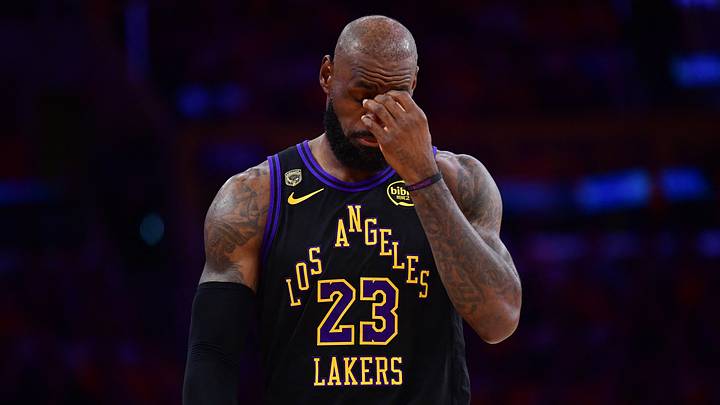
LeBron James saved the Los Angeles Lakers from the depths of uncharacteristic despair. The Lakers had missed the playoffs in a franchise record six consecutive seasons when James and Anthony Davis guided them to their first title in a decade. As such, losing James to free agency in 2026 stings.
For as fair as it may be to lament his departure, the reality in Los Angeles is that the Lakers needed to move on from him to finally build a sustainable roster.
James may be rewriting the laws of durability and longevity, but there are two sides to that coin. One permits endless praise for how he's maintained a star caliber of play well beyond when most have either opted or been forced by their bodies' limitations to retire from the NBA.
The other is that Los Angeles spent the better part of James' tenure not knowing how much longer he could sustain his quality—primarily due to the fact that there was no precedent for what he was doing.
Perhaps their world would look different had Davis avoided injuries or had Alex Caruso opted to overlook the Lakers' slight and re-sign for less than he could make elsewhere. In the world they live in, however, Los Angeles built teams that were never meant to last beyond the present season.
By parting ways with James, however, the Lakers have finally embraced the need to build sustainable quality around players who are under 30 and trending upward in their development.
Lakers are finally prioritizing sustainability throughout their rotation
The Lakers were steadily criticized during the James era for trading first-round draft picks for short-term solutions. They did so in three separate trades for point guards D'Angelo Russell, Dennis Schröder, and Russell Westbrook. They also parted with four second-round picks between the Dorian Finney-Smith and Luke Kennard trades.
Finney-Smith, Kennard, and Schröder all signed elsewhere after spending just one season with the Lakers. Russell and Westbrook failed to play two full seasons in Los Angeles before they were traded—and the purple and gold had to attach draft capital to offload them.
Flawed as those moves may have been, they were made with an expedited and short-term timeline in mind. The Lakers weren't building a team that could win for the next three-to-five years, but a group that could help James while he was still playing at a star level deep into his 30s—and then into his 40s.
With 27-year-old Luka Doncic now leading the charge, however, the Lakers have invested in a combination of up-and-comers and prime-year players with long-term contracts.
LeBron's longevity was brilliant, but no one knew how long it would last
Simple sports math would suggest that a 27-year-old superstar has more years to spare than a player in their late 30s or early 40s. Doncic is entering his athletic prime, after all, and is already a six-time All-NBA First Team honoree and two-time scoring champion who has led teams to the NBA Finals in 2024 and the Conference Finals in 2022 and 2024.
Alongside Doncic isn't a small group of developable players and a cast of aging veterans to support them, but a long list of under-30 players with room to grow or athleticism to offer.
Starting center Walker Kessler is a 25-year-old shot-blocking prodigy who dominates the offensive glass and deters opponents from entering the paint. 26-year-old wing Quentin Grimes is a proven catch-and-shoot specialist and high-level defender who can guard multiple perimeter positions.
Sandro Mamukelashvili and Collin Sexton, meanwhile, are 27-year-old high-volume scorers who offer efficient shooting and reliable finishing around the rim. Each one of those four players received a multi-year deal.
Lakers needed to get younger and more athletic—and did
As it stands, the oldest player on Los Angeles' roster is 30-year-old backup center Kevon Looney. 29-year-old backup wing Matisse Thybulle is second in that regard and 28-year-old starting shooting guard Austin Reaves, whom the Lakers signed as an undrafted free agent in 2021, is third.
That all seems to be by design, as even the Lakers' offseason additions beyond the big-money investments have trended toward being developable up-and-comers with untapped potential.
Cameron Carr joins the Lakers as a rare first-round pick, for instance, and is 21 years of age with intriguing athleticism, shooting range, and length. 22-year-old Adou Thiero is an explosive defensive prospect whom Los Angeles drafted in the second round in 2025, and 24-year-old forwards Jake LaRavia and Ziaire Williams are a part of the group competing for the starting forward role.
Though there's an obvious case to be made that James could've coexisted with the up-and-coming talent, a part of what the Lakers are building relies on opportunity.
Lakers needed to clear up minutes, touches to develop up-and-comers
With James in the rotation, the Lakers would've been handing 30-plus minutes and a high usage rate to a third player. With him out of the picture, however, those minutes can be split among multiple players—much as those touches can be given to any number of individuals looking to learn through experience.
With two ball-dominant stars in Doncic and Reaves, there simply wasn't room for a third who may not have the remaining time in their career to grow alongside them.
That's harsh and perhaps unfair to James, who has defied retirement-based expectations at every turn. He referred, however, to signing with the Philadelphia 76ers as his, "Last decision." That would seemingly imply that his current two-year deal will be the final contract he signs in the NBA.
For a Lakers team that needs to develop talent internally and highlight Doncic and Reaves as focal points, that's the final confirmation they needed that parting with James was a necessary evil.
 Add us as a preferred source on Google