

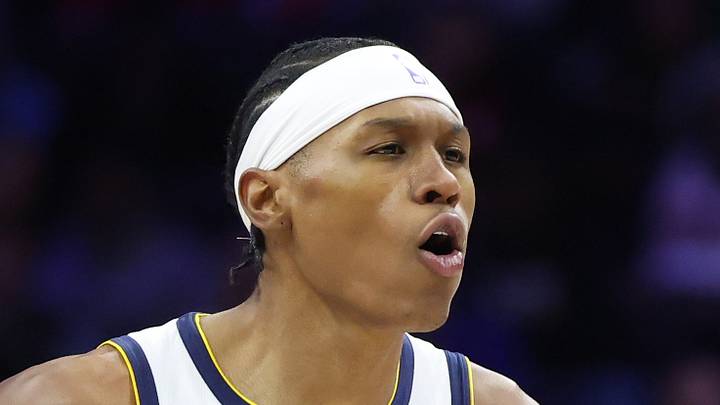
Peyton Watson was one of the top players on the Los Angeles Lakers' radar entering the offseason, but the restricted free agent they ended up with was Walker Kessler. That doesn't mean they couldn't have gone after the wing, but the Nuggets' price was enough to keep them away (and would Denver have really sent him to LA?), and he ended up in Cleveland instead. There may be a positive for Los Angeles in that, more than him leaving a rival.
On Aug. 21's episode of the Game Over with Max Kellerman and Rich Paul podcast, the latter, who is Watson's agent, said something that he probably should've kept to himself:
“You’ve got to remember, he didn’t finish the season. He didn’t play in the playoffs. He was dealing with a hamstring injury, soft tissue injury. And when you’re dealing with those injuries, you have to be very careful in your return. Guys want to play, and you have to protect them from themselves in that moment. Because you’re up for a contract and it’s the playoffs, and I’ve had a pretty good year, so I need to play. And it’s important to protect that.”
It sounds like Paul advised Watson to sit out
So, essentially, it seems Paul advised Watson not even to try to play in the playoffs, which, of course, isn't a good look. Soft-tissue injuries are tricky, and if you return before you're ready, they can be easily tweaked, leading to a longer recovery, but it seems like the wing was in a position where he could've at least played.
At the end of the day, it's a business, and Paul was doing what he believed was best for his client, but that's not a respectable approach, especially not when you have Aaron Gordon out there giving it his all while dealing with calf issues.
You can say that because Denver chose not to pay Watson and Christian Braun before last season began, which was a business decision, so P-Wat chose not to play in the 2026 playoffs to avoid putting his free-agency payday in jeopardy, making a business decision of his own.
I'm not here to bash Watson for not making more of an effort to play in the postseason if he could have, as it sounds like he wanted to be out there but decided to follow Paul's advice instead. If that was the case, he wasn't the first player to do so, and he won't be the last.
Signing Watson still would've been nice, but what Paul said makes you think twice
From a prospective team's perspective, it casts the player in a negative light, suggesting they put themselves above the team's best interests. Now, if a player rushed back before they should've to help their team in the playoffs, that's another thing. This doesn't sound like that, though.
It's worth wondering whether it'll happen again, like when Watson is due for an extension, something the Cavaliers will have to think about down the road.
Now, is it a deal-breaker for P-Wat? Absolutely not. He's a soon-to-be 24-year-old who is coming off a breakout-ish season (that was cut short) and can grow into a long-term piece in his new home, which is Cleveland. His skillset puts him in high demand.
But when you compare Watson's situation to someone like Austin Reaves, who suffered an oblique strain in early April and fought to return during the playoffs, coming back in Game 5 of the first round, Reaves' deal looks better. He was due for an even bigger payday than P-Wat, but that didn't keep him from getting back out there. That's the mentality you want a player to have.
Cleveland is still rejoicing over the Watson signing, as he's the exact kind of player they've been looking for (and a pretty good pivot after missing out on LeBron James), so the fan base probably isn't paying a lot of mind to what Paul said. They can only hope it won't be a sign of what's to come, which, for the Lakers, isn't something they have to worry about at all, which could work in their favor.
 Add us as a preferred source on Google