

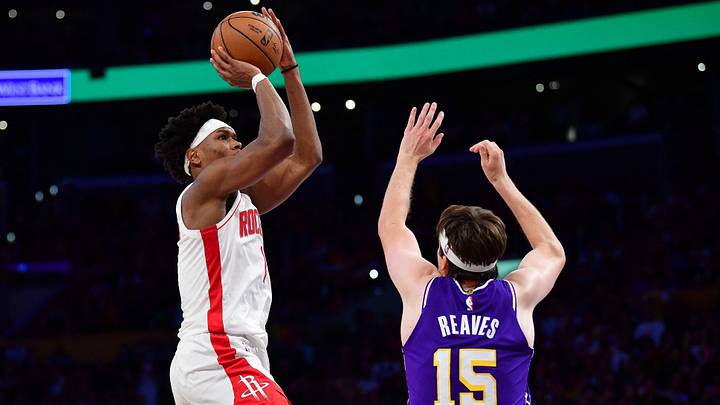
Amen Thompson and Austin Reaves just got paid in the same offseason cycle, and it begs the question: which team got the better deal? Also, were either of these guys overpaid? Let's dive in.
Thompson’s five-year, $208 million extension with the Houston Rockets ($41.6 million AAV, 10% trade kicker, through 2031-32) landed Thursday.
Back in June, Reaves and the Los Angeles Lakers locked in a four-year, $185 million max deal ($46.2 million AAV, player option in 2029-30). To determine the value of these contracts, we sort of have to determine the value of each basketball player.
Identifying the player profiles of Amen Thompson and Austin Reaves
Amen Thompson
Thompson, 23, is one of the most athletically gifted players in the entire NBA. At 6-foot-7 with length and limitless bounce, Thompson is also durable. He led the NBA in minutes played last season, averaging 18.3 points, 7.8 rebounds, and 5.3 assists per game.
Thompson's defense is his strength. He made the All-Defensive First Team in 2024-25 and finished fifth in Defensive Player of the Year voting that season. Last year, he finished eighth in voting for the award.
Offensively, Thompson is very much a work in progress. His ball-handling and decision-making have steadily improved, but his jumper is still not a weapon, and it may never be. Actually, 21.6% from 3 is a liability.
I see some similarities between Thompson and a young Russell Westbrook. Thompson is a much better defender (and much bigger), whereas Westbrook was a much better scorer. Neither were great shooters. Westbrook lived in the high 20s or low 30s for 3-point percentage for most of his career. He still won an MVP and will end up as a first-ballot Hall of Famer.
Austin Reaves
Reaves is a completely different player. His offensive game is absolutely elite whether you look at each offensive skill or the entire package. His numbers last season revealed a well-rounded weapon: 23.3 points, 5.5 assists, and 4.7 rebounds per game on 49/36/87 shooting.
Reaves has limitations athletically and is thus not a good NBA defender. He's also not totally durable, but at least we know that he loves playing basketball and has the toughness and accountability gene to get out there even when he's not 100%.
In my view, Reaves is good enough to be a legitimate No. 2 on a championship team, as long as your No. 1 is a two-way player. (This is an issue for the Lakers, but that's another story).
Were either of these guys overpaid?
It's tough to say that Reaves was overpaid when we know that other teams like the Detroit Pistons and Brooklyn Nets were reportedly competing with the Lakers for his services (or at least knocking on the door). The NBA generally rewards guys with max money who can score at the level of a first option, which Reaves has shown the capacity to do on plenty of nights.
Thompson's awful shooting would be the trait you'd point at if you were trying to argue that his deal is too lavish. But the counterargument is his relative youth. The Rockets are investing in Thompson's future, not necessarily paying him for what he's already done. In this sense, it's not an overpay.
In fact, given Thompson's age and durability, you could argue that Houston got the "better deal" here when comparing Thompson and Reaves. If Thompson continues to improve, he'll look like a max player in a year or two (even without a jumper! Westbrook did it!), which means the Rockets will have him on a "bargain" deal at that point.
What this says about the NBA
Reaves getting paid shows that scoring and playmaking are still the most rewarded traits. Teams will give you a max deal if you can do those things, even sometimes if your defense is average or bad.
There's also a science to getting ahead of things and locking in a guy like Thompson on a long-term extension before he takes another huge leap. As I mentioned, what looks like a slight overpay now could end up looking like a discount if Thompson fulfills his potential.
These were both fair deals in my view. Neither guy was grossly overpaid, and both teams had good reasons for forging ahead with these contracts.
 Add us as a preferred source on Google